
How to Search Mississippi Court Records
There is no single free search that contains every Mississippi trial case. Mississippi Electronic Courts, or MEC, is the electronic filing and case-management program used by participating courts. Public Access to Mississippi Electronic Courts, known as PAMEC, provides paid subscriber access through its registration and payment gateway. Its own terms describe coverage as various state courts. Justice, Municipal, older paper, sealed, and nonparticipating court files may be absent. The county clerk remains the source for the filed record and any certified copy.
Start with the party's full legal name, a cause number if known, the likely filing year, the county, and the case type. A felony or Circuit civil matter goes to the Circuit Clerk. Divorce, custody, estate, guardianship, and land cases go to the Chancery Clerk. Justice and Municipal Courts keep their own lower-court dockets. If the filing county is unknown, use residence, incident location, land location, or the court named on a notice to narrow the route. Appellate cases have a separate free Judiciary docket search.
- Identify the court type and county before searching.
- Check PAMEC if the trial court participates, or use the Judiciary appellate docket for an appeal.
- If the case is missing, open the county directory and choose the local court site.
- Search by cause number or party name, then compare the filing date and court.
- Ask the record-holding clerk for a plain, certified, or exemplified copy based on its intended use.
The PAMEC access layer is useful, but the local clerk still controls certification, omitted paper files, exhibits, and court-specific restrictions.
Mississippi Court Records by Court
Mississippi preserves a major split between courts of law and courts of equity. Circuit Courts hear felonies, jury matters, general civil claims, and many administrative appeals. Chancery Courts hear divorce, custody, land-title disputes, estates, wills, guardianships, conservatorships, and commitments. Both use multicounty judicial districts, yet each county keeps its own files through separate elected clerks. County Courts operate in only 23 counties and overlap selected civil, criminal, youth, and lower-court appeal work.
The Supreme Court of Mississippi is the final state appellate tribunal. The ten-judge Mississippi Court of Appeals is one statewide court, although judges are elected from five districts. Justice Courts handle small civil cases, evictions, misdemeanors, county tickets, and early felony proceedings. Municipal Courts hear city ordinance, misdemeanor, traffic, bond, and initial-appearance matters. The full Mississippi court system profile explains the less common Youth, intervention, and Capitol Complex Improvement District courts.
Typical appeal flow: Justice or Municipal Court › County Court where available or Circuit Court › Supreme Court or assigned Court of Appeals › Supreme Court review.
| Court | Jurisdiction | Case Types |
|---|---|---|
| Supreme Court and Court of Appeals | State appellate review | Assigned civil, criminal, domestic, and direct-review matters |
| Circuit Court | Law and general criminal jurisdiction | Felonies, civil suits, jury trials, administrative appeals |
| Chancery Court | Equity jurisdiction | Family, land, probate, guardianship, commitment |
| County Court | Limited overlapping jurisdiction in 23 counties | Selected civil, misdemeanor, youth, and lower-court appeals |
| Justice and Municipal Courts | Local lower-court jurisdiction | Small claims, misdemeanors, ordinances, traffic, initial appearances |
Types of Mississippi Court Records
Case type determines both the court and custodian. Mississippi Circuit records include felony indictments, pleas, trials, sentences, larger civil disputes, jury materials, and appeals from lower courts. Chancery records contain divorce pleadings, support and custody orders, deeds and land disputes, wills, estate administration, guardianships, and conservatorships. County, Justice, and Municipal records cover their narrower local jurisdiction. An appellate record contains briefs, the record excerpts, motions, orders, opinions, and mandates rather than every trial exhibit.
- Criminal records: the filed charge, docket, plea, motions, disposition, and sentence in the court case.
- Civil records: complaints, answers, service, discovery notices, motions, judgments, and enforcement entries.
- Family records: divorce, custody, support, and related Chancery orders, subject to privacy limits.
- Probate records: wills, letters, inventories, creditor notices, accountings, and closing decrees.
- Traffic records: citations, pleas, settings, findings, fines, and failure-to-appear events held by the issuing court.
- Youth and sensitive records: protected files that are not ordinary public court records.
What Mississippi Court Records Show
A docket is the chronological index to a case. It normally identifies the court, county, parties, cause number, filing date, attorneys, assigned judge, events, document descriptions, hearings, and outcome. A docket entry is not always the document itself. PAMEC or a local portal may show an event while charging for the linked image, withholding a restricted filing, or requiring the clerk to retrieve the paper original. Status words also matter. Filed, pending, dismissed, no bill, nolle prosequi, guilty, acquitted, and remanded describe different stages and results.
- Cause number
- The court's unique identifier and the fastest way to request the right file.
- Filing date
- When the action or charging instrument entered the Mississippi record.
- Parties
- Plaintiffs and defendants, the state and accused, or petitioners and respondents.
- Charge or cause
- The alleged offense, civil claim, or Chancery subject involved.
- Docket events
- Filings, service, settings, continuances, hearings, orders, and other case activity.
- Disposition
- How a claim or charge ended, including dismissal, plea, verdict, judgment, or transfer.
- Sentence or judgment
- The ordered penalty, damages, relief, custody term, or other final directive.
Statewide Mississippi Record Systems
Some records sit outside the county court file. The Mississippi Department of Corrections searches people in state custody or supervision, not everyone held in a county jail. The Mississippi Department of Public Safety Criminal Information Center maintains the state criminal-history repository, while a court clerk preserves the source case. The Driver Service Bureau sells certified motor vehicle records. The Mississippi State Department of Health keeps marriage statistical records and a divorce index, but a Circuit Clerk holds the original marriage license and a Chancery Clerk issues the divorce decree.
The Mississippi Sex Offender Registry is another distinct public system. Its profiles do not replace the conviction docket or prove current custody. Mississippi SAVIN/VINE can provide confidential custody-status notices for participating local jails and MDOC. Each system answers a narrow question. A complete search may require both the statewide result and the local file that created it.
| System | What It Holds | Run By |
|---|---|---|
| MDOC Inmate and Parolee Search | State custody and supervision information | Mississippi Department of Corrections |
| CIC Criminal History System | Authorized Mississippi criminal-history releases | Department of Public Safety |
| Motor Vehicle Record service | Driving history and license-related entries | DPS Driver Service Bureau |
| Vital Records marriage and divorce services | Marriage records and divorce county index searches | Mississippi State Department of Health |
| Sex Offender Registry | Statutorily public registration profiles | Department of Public Safety |
The official state portal overview places the Supreme Court and Court of Appeals within Mississippi government services.
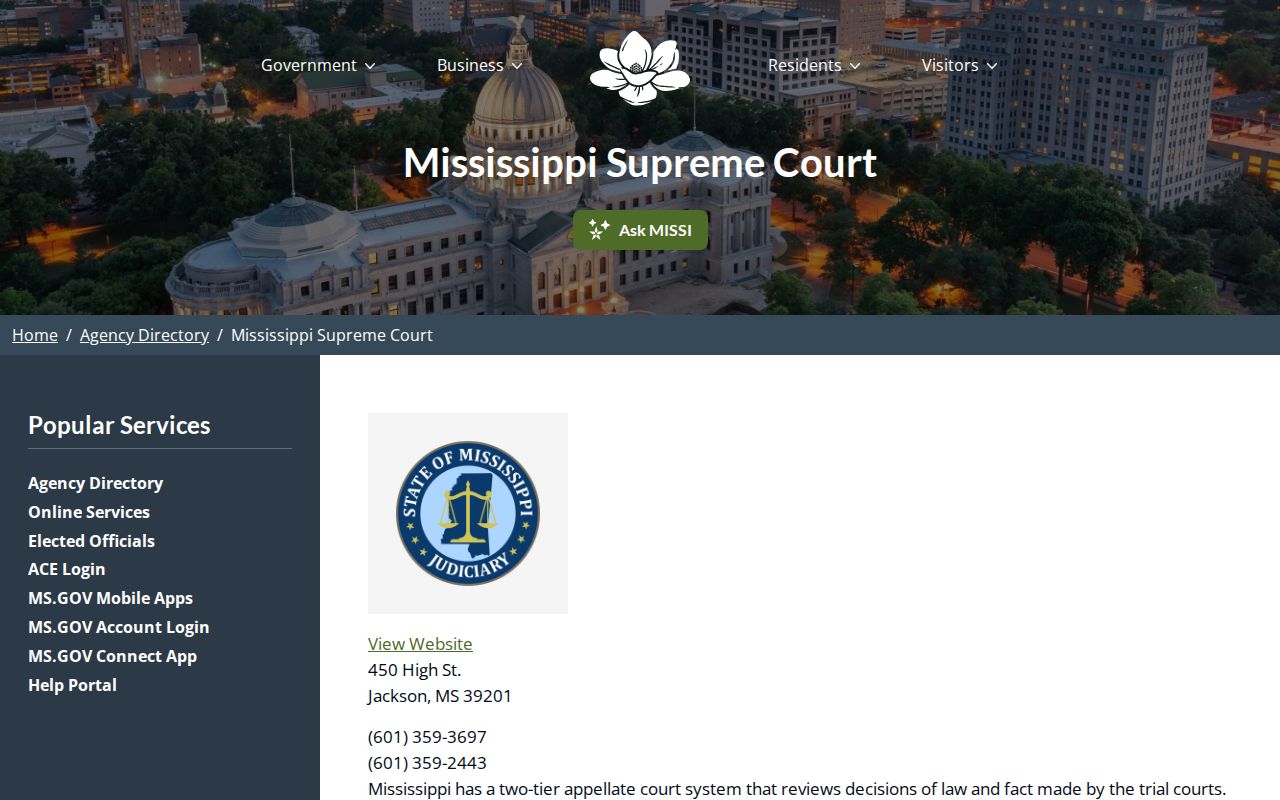
The state overview helps identify appellate resources, while trial records still follow MEC participation and county custody.
Mississippi Court Records Access Laws
The Mississippi Public Records Act, Miss. Code Ann. sections 25-61-1 through 25-61-19, gives access to nonexempt public-body records under reasonable procedures and permits actual-cost charges. Judicial records also remain subject to court rules, sealing orders, and subject-specific confidentiality law. A request should go to the custodian that made or keeps the record. It should name the court or agency, county, person or case, dates, and exact documents. Ask for inspection or electronic delivery when that will meet the need.
Key Statutes:
Miss. Code Ann. §§ 25-61-1 through 25-61-19 establish the Public Records Act and actual-cost framework.
Miss. Code Ann. § 99-19-71 supplies offense-specific paths for eligible criminal expungement.
Miss. Code Ann. §§ 43-21-251 and 43-21-261 restrict Youth Court records and disclosures.
Mississippi Rule of Civil Procedure 5.2 protects specified personal identifiers in court filings.
If access is denied, ask the custodian to identify the controlling exemption and release any reasonably separable public portion. The Attorney General and Ethics Commission offer guidance, but neither substitutes for the clerk, court, sheriff, MDOC, DPS, or health office that holds the requested record.
Restricted Mississippi Court Records
Public access does not make every filing open. Youth Court records are confidential under a separate statutory system. Adoption files are sealed, and Chancery mental-health matters contain protected medical information. Courts redact Social Security numbers, financial account details, minors' information, victim locations, and other protected data from otherwise public cases. A missing online case can also reflect an expungement, sealing order, nonparticipating court, old paper file, or an incorrect county rather than proof that no case exists.
Mississippi expungement is not automatic. Eligibility depends on the charge, disposition, prior history, and statutory conditions. The motion is filed in the court that controlled the case, usually in the county of disposition. A certified disposition and accurate cause number help the court and Criminal Information Center process the order. Even after relief is granted, authorized government uses may remain and private copies may need a separate correction supported by the certified order.
Note: A public docket entry may remain visible while the underlying filing is sealed, redacted, unavailable online, or released only by court order.
Find Mississippi Court Records by County
Every Mississippi county has a separate court-records route because local clerks preserve trial files even when judges serve a multicounty district. The major metro and Gulf Coast counties below carry high volumes across Circuit, Chancery, County, Justice, and Municipal Courts. Several also have two courthouse locations, so confirm the correct district or seat before requesting a paper file.
Hinds County
Jackson and Raymond · Capital-area courts and two-seat filing routes
Harrison County
Biloxi and Gulfport · Gulf Coast county and municipal court network
DeSoto County
Hernando · Fast-growing Memphis metro court system
Rankin County
Brandon · Jackson metro Circuit, Chancery, County, and Justice Courts
Jackson County
Pascagoula · Gulf Coast county, circuit, chancery, and city records
Madison County
Canton · High-growth civil, land, family, and lower-court filings
Browse the full directory of all 82 Mississippi counties to open the court records site for any county.
Mississippi Court Records Fees
Mississippi does not publish one checkout total for every court request. Clerk copy, certification, archive retrieval, postage, filing, process, publication, and payment-card charges depend on the county and service. Ask for a written quote. State systems have separate verified prices, and those fees do not purchase the underlying county case file. Inspection may avoid copy charges, but staff research, redaction, or archive retrieval may still carry an actual cost.
| Item | Amount |
|---|---|
| PAMEC public access | Paid subscription; current usage schedule shown during registration |
| CIC released background | $32 with required authorization, identification, and money order |
| Certified MVR online | $14.31 |
| Certified MVR by mail or counter | $11 |
| MSDH marriage or divorce-index search | $17; $6 for an additional same marriage record |
| Clerk copy or certification | County and service dependent; request an estimate |
Read Mississippi Court Records Correctly
A charge is an accusation, not a conviction. An indictment means a grand jury found a basis to proceed, not that guilt was established. Nolle prosequi means the prosecution chose not to proceed at that time. No bill means the grand jury declined to indict. A dismissal without prejudice may allow later refiling, while a dismissal with prejudice ordinarily bars the same claim. Remanded means an appellate court sent the matter back for more action. De novo means the higher trial court hears a lower-court appeal anew instead of reviewing only the old record.
Read the event date, document description, and disposition together. A hearing calendar shows what was scheduled, not necessarily what occurred. A docket may list a judgment without displaying its pages. When the result will be used for a formal purpose, obtain the signed order or certified disposition from the clerk rather than relying on a search-result label.
- Cause number
- The unique court identifier for the case.
- Disposition
- The outcome of a charge, claim, or case.
- Mandate
- The appellate instruction returning authority to the lower court.
Mississippi Court Records Limits
Electronic coverage is court-specific and changes as Mississippi Electronic Courts expands. Paper-era files, lower courts, exhibits, sealed records, and some images will not appear in PAMEC. A state criminal history can also lag behind the court until a disposition or expungement order reaches CIC. Driving records update after courts report qualifying outcomes. State custody data differs from county booking data. Match the name, birth information where lawfully shown, court, cause number, and dates before treating two entries as the same person.
Note: Confirm a material result with the Mississippi clerk or agency that owns the source record before relying on an online entry.
The Secretary of State judicial directory provides current court terms and directory material used to verify Mississippi court routes.
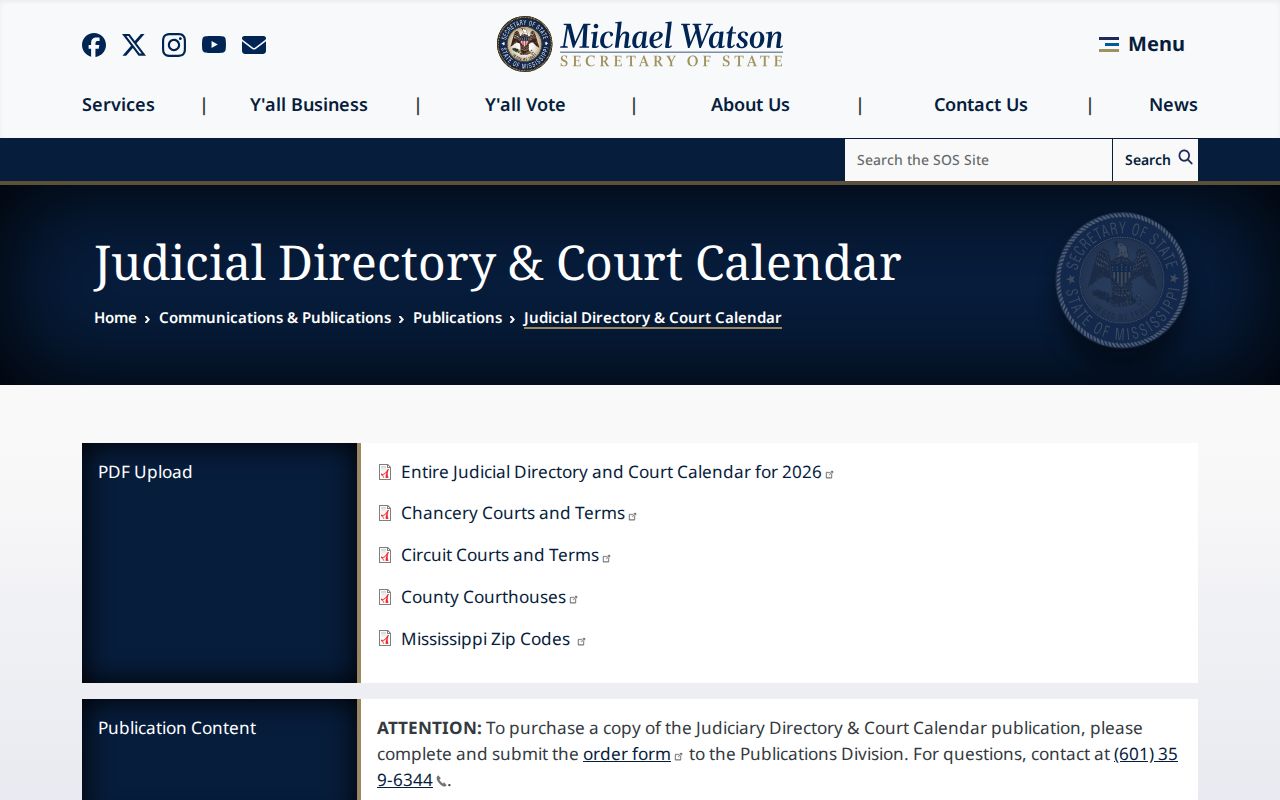
Because judicial terms and offices can change, the current directory is a better routing source than an old saved list.
Mississippi Court Records Questions
Is PAMEC a complete statewide search?
No. PAMEC covers participating Mississippi Electronic Courts and requires public registration and payment. Nonparticipating courts, many Justice and Municipal matters, historical paper cases, exhibits, and restricted documents may require a local clerk request.
Which clerk keeps a divorce or estate?
The Chancery Clerk in the filing county keeps divorce, custody, estate, will, guardianship, conservatorship, and land-related court files. The Circuit Clerk keeps Circuit criminal and civil cases and marriage licenses. Asking only for the county clerk can cause a Mississippi request to reach the wrong elected office.
Can the state health department issue a divorce decree?
No. MSDH can search its divorce index to identify the county, but the certified decree comes from that county's Chancery Clerk. For marriage, MSDH can provide its certified statistical record within its coverage, while the issuing Circuit Clerk preserves the original license and return.
Where are Mississippi warrant records searched?
No official public statewide warrant index was located. Check the issuing Circuit, Justice, Municipal, or County Court and the relevant sheriff or city police route. A bench warrant tied to a missed city case may not appear in a county-level electronic court search.
Are jail and prison searches the same?
No. County sheriffs operate jail rosters for local detainees. MDOC searches sentenced state prisoners and parolees. A person may appear in one system and not the other, and federal prisoners use the Bureau of Prisons locator.
What proves the final outcome?
A certified disposition, judgment, decree, or order from the record-holding clerk is the strongest source. A docket entry is an index. A criminal-history release is a compiled repository record. Each can answer a different question and may update on a different schedule.
The Secretary of State's 2026 judicial qualifying notice illustrates that Mississippi appellate and trial judges are elected and Circuit Clerks support county qualifying.
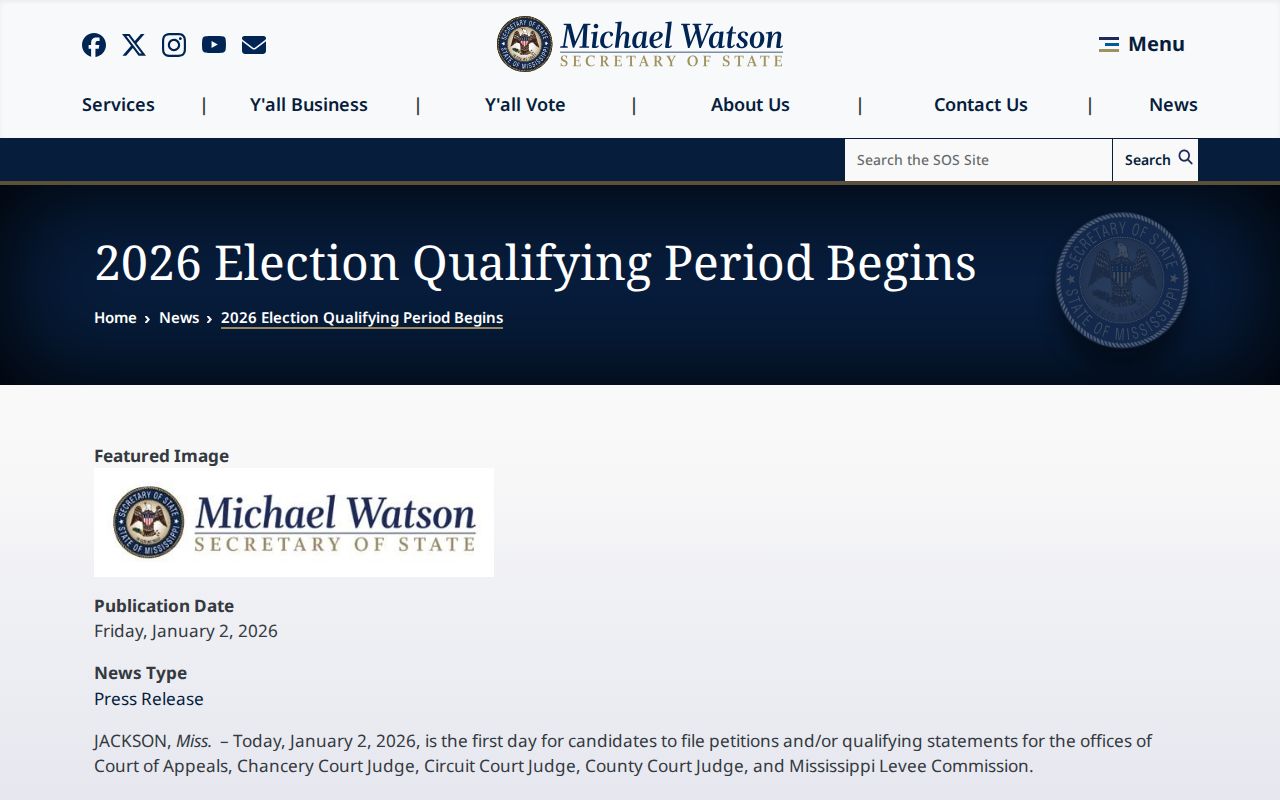
That election structure does not merge records into one office. Each filing county continues to control its own trial files.