
Active Mississippi Warrant Records
Mississippi judges and judicial officers issue warrants within a case or on a sworn probable-cause showing. The issuing court and executing sheriff or police agency hold the authoritative data. Mississippi participates in CIC and NCIC law-enforcement systems, but those tools are authenticated for official use and are not public name-search sites. No official open statewide warrant index was found. A commercial claim of a complete statewide result should not be presented as official clearance.
Public access differs by place. Some sheriffs or police departments publish wanted lists or official apps. Others require a call to the clerk or warrants unit. Lists can omit new, sealed, juvenile, out-of-county, and nonpublished warrants. Use the Mississippi county directory to reach the issuing county, then check the city Municipal Court and county Justice Court as well as Circuit Court. Absence from one list is not proof that no warrant exists.
Mississippi Warrant Types
The document type determines where to look and what can be released. A person warrant is different from a search warrant. Family, juvenile, and interstate matters also have separate custodians and access limits.
- Arrest warrant: a judicial command based on probable cause, held by the court and executing agency.
- Bench warrant: a judge-issued command often tied to failure to appear or comply.
- Search warrant: authority to search a defined person, place, or property; affidavits and returns may be sealed during an investigation.
- Capias: a writ directing arrest, often entered after indictment or nonappearance in a pending case.
- Support or contempt warrant: a Chancery matter that may contain protected family information.
How to Search Mississippi Warrants
Build a venue list before searching. Include the offense county, arrest county, municipality, the Justice Court district, Circuit or County Court, and any Chancery support matter. Use a full legal name, aliases, date of birth when lawfully requested, citation or cause number, and likely issue date. Name-only matches are risky because common names can identify different people.
Use only a court, county, sheriff, or police source. If no online lookup exists, ask the clerk or warrants unit whether identity can be checked remotely and what data is needed. Do not call 911 for a routine records check. Staff may confirm limited fields but cannot promise that approaching a counter will not result in arrest.
- Open the county directory and select each plausible issuing county.
- Check the official sheriff or police source and each relevant court.
- Search by exact name and use date of birth or case number only when the official system supports it.
- Match the warrant number, issuing court, charge, and issue date, not the name alone.
- Confirm the result and current status directly with the issuing office or through counsel.
Mississippi Warrant Search Fields
Mississippi official interfaces are local and do not share one fixed search form. These are common fields on a released roster. A system may offer fewer fields, require a direct call, or publish only selected wanted people.
| Field Label | Type | Required | Notes |
|---|---|---|---|
| Last Name | Text | Portal dependent | Start with the exact legal spelling; wildcard support is local. |
| First Name | Text | Portal dependent | Narrows common surnames; check aliases separately if supported. |
| Date of Birth | Date | Portal dependent | Useful for identity matching but not always released. |
| Warrant or Case Number | Text | No | The strongest identifier when known. |
What Mississippi Warrant Records Show
A released listing can show enough data to route a confirmation, but it is not the full underlying criminal case. Fields vary with the agency, warrant type, safety concerns, and current access rules.
| Field | What It Shows |
|---|---|
| Warrant Number | The issuing office's identifier used for confirmation. |
| Issue Date | When the court issued the command; it does not prove current status. |
| Charge | The alleged offense or underlying noncompliance, not a conviction. |
| Bond | An amount or type if released; a judge may later change it. |
| Issuing Court | The court that controls recall, appearance, and the related case. |
| Identity | Name, alias, age, date of birth, or photograph when lawfully released. |
Find Mississippi Warrants by County
Mississippi has 82 counties, and each local route can differ. The issuing court is the key. Circuit Court handles felony capias matters. Justice and Municipal Courts generate many misdemeanor, traffic, and failure-to-appear warrants. County Court may matter where it exists, while Chancery Court can control support or civil-contempt process. Search the Mississippi county directory, then contact both the court clerk and the sheriff or city police when appropriate.
A local most-wanted post, sheriff app, roundup notice, or amnesty event is selective and date-limited. It is not a full warrant database. An app is official only when the agency itself links it. Save the agency name and publication date, then confirm live status before making any decision.
When the county is uncertain, trace the event that could have produced the warrant. A missed city citation points first to Municipal Court. A county traffic case or misdemeanor may begin in Justice Court. A felony indictment or failure to appear in Circuit Court points to the Circuit Clerk and sheriff. Child-support or Chancery contempt process follows the Chancery file. A person who lived in one county but was cited, charged, or ordered to appear in another should check the issuing jurisdiction, not only the home address.
Resolve a Mississippi Warrant
A Mississippi attorney can contact the issuing court, confirm the case and bond terms, and arrange an appearance or surrender without an uninformed counter visit. Verify the warrant number, charge or citation, issuing judge or court, current bond conditions, and next setting. Follow only the issuing court's instructions. Paying an online balance does not necessarily recall a warrant until a judge or clerk processes the required action.
After appearance, payment where legally permitted, bond, motion, or recall, obtain a receipt or signed order showing the warrant was quashed or recalled. Ask when the court transmits the update to law enforcement, and keep proof because connected systems may lag.
Do not rely on a caller, text message, or email that demands immediate payment by gift card, wire, cryptocurrency, or another hard-to-reverse method. Confirm the court through its independently located official number. Mississippi courts may set fines, costs, bond, or appearance terms, but the current docket and clerk instructions should match the demand. If identity is disputed, an attorney can compare the name, date of birth, cause number, charge, and issue date without treating a same-name result as confirmation.
Important: Consult a licensed Mississippi attorney before surrender or travel, especially when bond, extradition, or immediate arrest risk is unclear.
Mississippi Wanted Lists and Tips
Individual Mississippi agencies may publish selected wanted people and local tip instructions. The research did not identify one official statewide public Crime Stoppers warrant portal. Follow the exact law-enforcement source for the jurisdiction, and never approach a wanted person. A tip channel is for information about another person, not for obtaining legal advice or resolving one's own warrant.
The official DPS crash-report service illustrates a separate police-record purchase system.
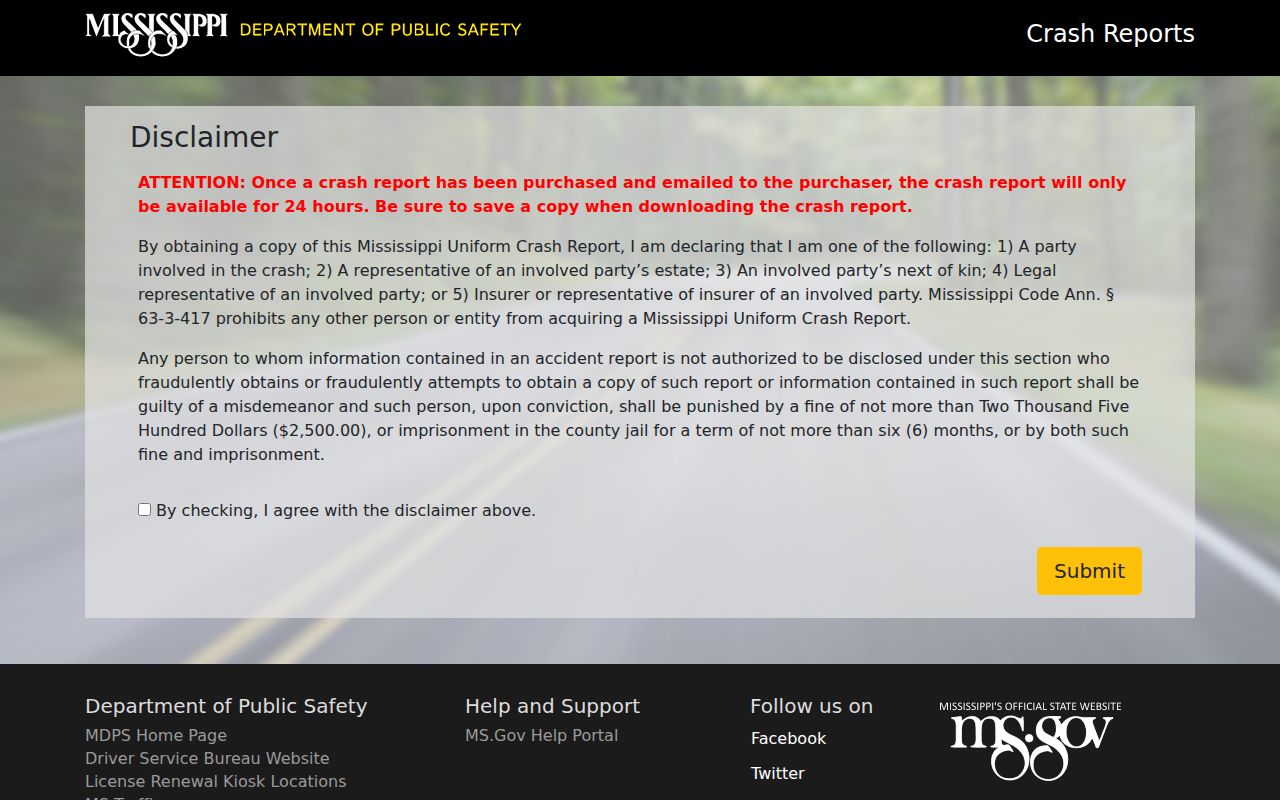
A crash-report result must never be confused with a Mississippi warrant check or court confirmation.
Restricted Mississippi Warrant Records
Search-warrant affidavits and returns may be sealed during an active investigation. Youth Court warrants and custody orders are confidential. Family records may contain protected child, address, or financial data. Sealed or expunged matters follow the controlling order. Federal warrants are not county court records, and law-enforcement CIC or NCIC entries are not public merely because an agency can view them. Ask for any segregable, releasable portion, but do not assume a denial proves there is no warrant.
A focused public-record request can seek a releasable warrant log, capias order, return, or related docket entry. Send it to the office that keeps that record, not to a general statewide agency. Include the subject's full legal name, aliases if known, approximate issue date, county, city, issuing court, and case or citation number. Ask whether the office can provide a redacted portion if some information is exempt. Mississippi public bodies may use reasonable procedures and charge actual costs for search, review, redaction, and reproduction.
Warrant status can change after a hearing, payment, recall order, bond, or service. An online list may update on a different schedule than the court docket or sheriff system. That is why the issuing court's current instruction and written recall proof matter more than a cached search result. If the underlying case is a traffic or misdemeanor matter, check the Municipal or Justice Court rather than stopping after a Circuit Court search. For a felony capias, confirm the Circuit Court cause number and order.
Note: A public list is a lead for confirmation, not legal clearance, and a stale entry may remain after a court changes status.