
How to Search Mississippi Court Records
Mississippi does not offer one free name search covering every state and local court. The Mississippi Electronic Courts program supports e-filing and case management only in participating trial courts. Public users register through Public Access to Mississippi Electronic Courts, or PAMEC, then select an available court database. The service is subscription based. It can expose indexes, docket events, and some documents from participating Circuit, Chancery, and County Courts, but it does not make every Justice Court, Municipal Court, historical volume, or nonparticipating court searchable.
Start with the filing county, not merely a person's present residence. Criminal venue usually follows the place of the alleged offense. Land cases generally follow the land, while domestic and probate venue depends on facts specific to those proceedings. Gather the exact party name, former names or initials, an approximate filing year, case type, and cause number if known. A cause number is the strongest match because Mississippi formats differ by court and database. If PAMEC lacks the case, contact the local clerk. The official file, sealed-access decision, certified copy, exhibit, transcript, and older paper index remain under that court's control.
- Check the MEC participating-court list, then register for PAMEC through the public or non-attorney path if the correct court participates.
- Select the court database and search the exact cause number. If it is unknown, use party names and narrow by date, type, and role.
- Read the result as an index. Match the county, filing date, attorneys, case category, and outcome before treating it as the correct person or case.
- Open the docket history and identify the complaint, petition, indictment, orders, judgment, sentence, appeal, or other event needed.
- Request missing documents or certification from the filing clerk. Give the cause number, event date, document title, and requested copy type.
Mississippi Court Records Search Fields
PAMEC registration requires identity, contact, credential, terms, and payment information before a user reaches participating databases. Search controls then vary by court instance. The fields below reflect the statewide PAMEC workflow and the common trial-court search choices documented for Mississippi. Local clerk systems may expose fewer or different filters. Exact spelling matters, and a search should include name variations when the cause number is unavailable.
| Field Label | Type | Required | Notes / Format |
|---|---|---|---|
| Court database | Link or selection | Yes | Only participating MEC court instances appear. |
| Party name | Text | Search dependent | Try exact spelling, former names, initials, and legal business names. |
| Case number | Text | Search dependent | Preserve letters and hyphens; formats differ among courts. |
| Date range | Date filter | No | Availability depends on the selected court database. |
| Case type | Filter | No | Useful for separating civil, criminal, domestic, and probate matters. |
| Search or clear | Action | No | Runs the query or resets the selected fields. |
Non-MEC Mississippi Court Records
A PAMEC miss is a routing signal, not proof that a case does not exist. Mississippi Electronic Courts was adopted court by court, and its coverage remains tied to participating instances. Justice Court evictions and misdemeanors, Municipal Court traffic and ordinance matters, paper-era Circuit or Chancery cases, and some County Court records may require a manual local search. Ask the clerk which years are indexed, whether a file is stored off-site, and whether staff need a name, year, docket book, or cause number. For appellate cases, the Mississippi Judiciary provides free Supreme Court and Court of Appeals docket and opinion access separate from PAMEC.
The official PAMEC registration gateway shows the public account route used for participating Mississippi court records.
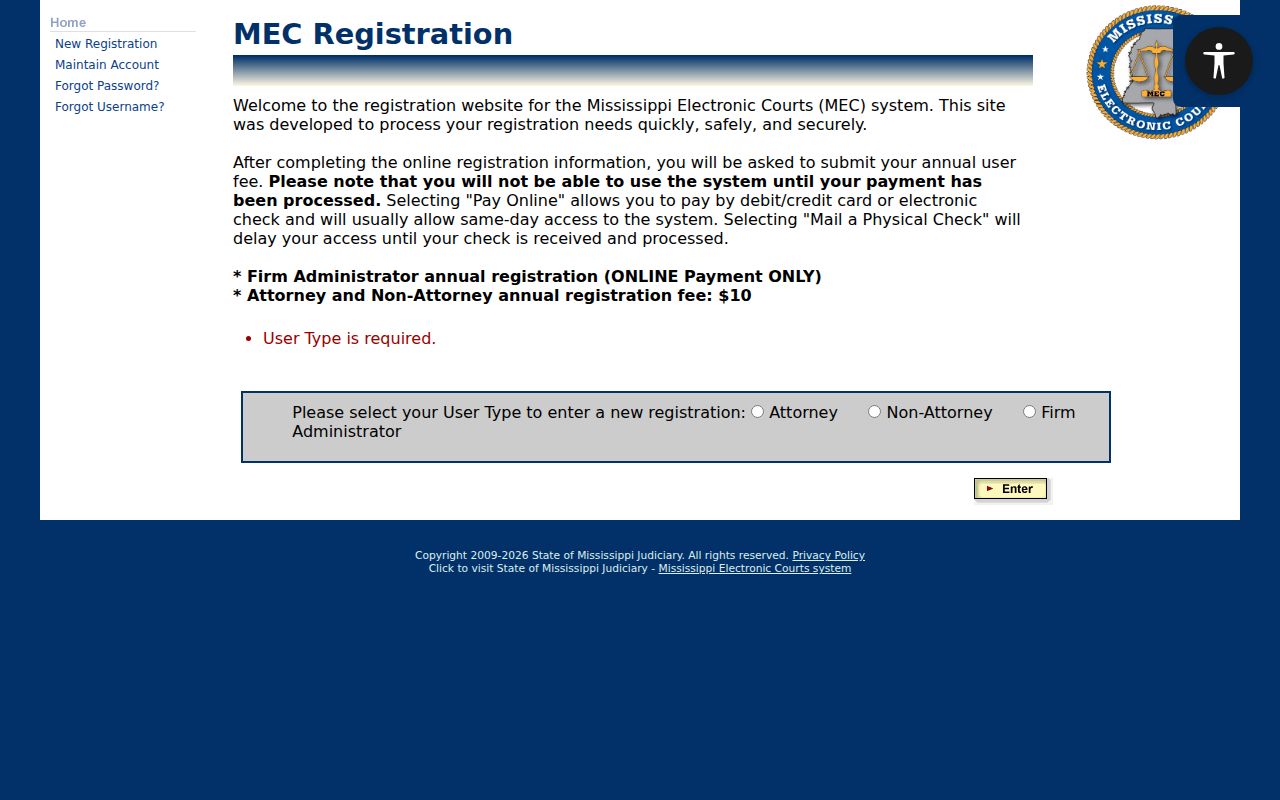
The registration screen illustrates why online trial access is an account service, while certified documents and courts outside MEC still require the filing clerk. For a written request, include the requester's contact details, court, county, case number, party names, date range, document titles, copy type, delivery method, and maximum approved cost. Do not mail cash. If the clerk cannot release part of a record, ask whether a redacted version or the unrestricted docket can be supplied.
Types of Mississippi Court Records
Mississippi divides trial work by both subject and court level. Circuit Courts are courts of law. Their clerks preserve felony files, general civil actions, jury records, judgments, and many appeals from lower courts. Chancery Courts exercise equity jurisdiction and produce divorce, custody, support, land-title, estate, guardianship, conservatorship, and commitment records. County Courts exist only in some counties and overlap limited civil, criminal, youth, and lower-court appeal jurisdiction. Justice and Municipal Courts maintain their own misdemeanor, small-claim, eviction, ordinance, traffic, bond, and preliminary felony records.
The record category identifies the custodian. Circuit Clerks keep Circuit criminal and civil records and issue marriage licenses. Chancery Clerks keep family, probate, equity, and land records. Justice and Municipal Court clerks hold local lower-court dockets unless an appeal creates a separate file in County or Circuit Court. Youth records are confidential, and a missing public result does not prove that no proceeding occurred. The broad categories include:
- Civil records with complaints, service, answers, motions, orders, verdicts, judgments, enforcement, and appeal notices.
- Criminal records with complaints or indictments, arraignment, pleas, motions, verdicts, sentences, costs, bonds, and appeals.
- Chancery records for divorce, custody, support, probate, land disputes, guardianships, conservatorships, and commitments.
- Traffic and ordinance files with citations, plea or hearing events, payments, warrants, judgments, and reports to DPS.
- Appellate records with notices, record designations, briefs, orders, opinions, mandates, and costs.
What Mississippi Court Records Show
A Mississippi case result usually begins with the court, filing county, cause number, case style, category, filing date, assigned judge or chancellor, and open or closed status. Party entries identify each plaintiff, defendant, petitioner, or respondent and may list counsel and public service addresses. The event register records filed and entered dates, document titles, hearings, returns of service, orders, and disposition. Criminal detail may include counts, charge descriptions, pleas, adjudications, sentences, restitution, costs, and bond events. Access to attachments depends on the court, document, subscription, and privacy status.
| Field | What It Shows |
|---|---|
| Cause number | Local identifier that must be paired with the court and county. |
| Case style and type | Named parties and the civil, criminal, domestic, probate, or other category. |
| Filing date and status | When the matter opened and whether it is pending, closed, stayed, transferred, appealed, or reopened. |
| Parties and counsel | Public names, legal roles, aliases where shown, and attorneys of record. |
| Docket events | Chronological filings, service, settings, motions, orders, judgments, and appeal activity. |
| Disposition | The outcome, such as judgment, dismissal, conviction, acquittal, or nolle prosequi. |
| Financial entries | Assessments, fines, costs, payments, or balances, subject to clerk accounting. |
| Documents | Available pleadings and orders; transcripts, exhibits, or certification may require a separate request. |
Public Access to Mississippi Court Records
The Mississippi Public Records Act, Miss. Code Ann. sections 25-61-1 through 25-61-19, supplies an access framework for nonexempt records held by public bodies. Court files are also governed by the judiciary's constitutional authority, court rules, sealing orders, and subject-specific confidentiality laws. A request to a clerk should name the court, county, cause number or parties, date range, and exact documents. Ask to inspect when copies are unnecessary, or request an estimate for research, retrieval, redaction, reproduction, certification, and delivery.
Mississippi does not have one universal clerk copy price for all case records. PAMEC is paid access, while a local clerk may charge county or statute-dependent per-page, search, archive, certification, postage, and payment fees. A plain copy may serve research needs. A certified copy bears the clerk's authentication for a receiving court, agency, bank, title company, or other authority. Screen prints are not certified records. An exemplified copy is a higher form of authentication and should be ordered only when the receiving body requires it.
Note: Mississippi public-record procedures cannot override a court sealing order, youth confidentiality law, or rule protecting personal data.
Restricted Mississippi Court Records
Youth Court files are confidential under Miss. Code Ann. sections 43-21-251 and 43-21-261, with access limited by statute or court order. Adoption files are sealed. Mental-health cases may contain protected medical and commitment evidence. Courts redact Social Security numbers, financial account numbers, protected birth dates, minor identities, confidential addresses, and victim information instead of closing an otherwise public file. Domestic-abuse, sexual-offense, guardianship, and conservatorship matters can include additional protected material. A denied attachment may reflect a restriction even when the public docket still shows an event.
Expungement is a court process, not an automatic database edit. Miss. Code Ann. section 99-19-71 provides paths for specified eligible outcomes and convictions, subject to offense, history, and timing rules. The petition goes to the court controlling the case. A filer should obtain the certified disposition, identify the charge and cause number, follow local notice and fee instructions, and keep certified copies of any granted order. The clerk and Criminal Information Center then carry out the order within their authorized systems. Private copies do not necessarily vanish at the same time.
Find Mississippi Court Records Offices
Every Mississippi county keeps local Circuit and Chancery records even when judges serve a multicounty district. Use the Mississippi county directory to reach the filing county, then choose the Circuit Clerk for felony, general civil, marriage-license, and commonly County Court material; the Chancery Clerk for divorce, custody, probate, guardianship, land, and equity files; or the named Justice or Municipal Court clerk for its local cases. The statewide Mississippi clerk structure explains which office holds each record and how to request a plain, certified, or exemplified copy.
Tip: Search the filing county first because a multicounty judicial district shares judges, not one merged court-record archive.