
Mississippi Marriage Record Custodians
The office split is exact. A Circuit Clerk issues the original marriage license and records the completed return. A Chancery Clerk holds a divorce action because divorce is a Chancery Court matter. The Mississippi State Department of Health, Bureau of Vital Records keeps statistical marriage records and provides a divorce-index search that identifies the filing county. MSDH does not maintain divorce decrees.
Quick reference: Ask the Circuit Clerk for an original marriage record, MSDH for a covered statistical marriage record or divorce county search, and the Chancery Clerk for the full divorce file and certified decree.
| Needed Record | Mississippi Custodian | What the Office Supplies |
|---|---|---|
| Marriage license or recorded return | Issuing county Circuit Clerk | Original county record and local certification |
| State marriage statistical record | MSDH Bureau of Vital Records | Search and certified copy for covered years |
| Divorce location search | MSDH Bureau of Vital Records | County identification, not a decree |
| Divorce petition, orders, or decree | Filing county Chancery Clerk | Complete court file and certified decree |
Apply for Mississippi Marriage Licenses
Contact the Circuit Clerk in the county where the application will be made. Ask for the current collection total, appointment practice, accepted payment, office hours, and the identity or age documents needed for the applicants' circumstances. Mississippi abolished the former premarital blood-test requirement. Both applicants generally appear and provide the information needed for the Statistical Record of Marriage.
- Select the county and confirm current requirements with its Circuit Clerk.
- Both applicants appear with identity, age, and any circumstance-specific documents.
- Complete and sign the clerk's marriage and statistical information.
- Pay the local collection total and receive the license.
- Have an authorized officiant complete and sign the ceremony section.
- Ensure the officiant returns it to the issuing Circuit Clerk within five days.
The Circuit Clerk records the completed instrument and forwards the statistical record to Vital Records. Mississippi does not recognize new common-law marriages. A relationship predating April 1, 1956 may raise a distinct historical issue, so the record and applicable law should be checked rather than assumed.
Mississippi Marriage Request Fields
The official state application is for a certified statistical marriage record, not a new county license. It gives a useful inventory of the facts needed to locate the event and prove eligibility. A Circuit Clerk may request more information on its own license application.
| Field Group | Information Requested |
|---|---|
| Parties | Both names on the record, including names before marriage |
| Event | Date, county, and five-year search range |
| Order | Number of certified copies |
| Applicant | Name, mailing address, phone, relationship, and purpose |
| Authority | Signature, date, and representative proof where applicable |
| Submission | Photo ID, accepted payment, and stamped return envelope |
Search Mississippi Marriage Records
MSDH coverage runs from January 1, 1926 through June 30, 1938, then from January 1, 1942 to the present. Records from July 1, 1938 through December 31, 1941 were kept only by the Circuit Clerk in the issuing county. MSDH also warns that a required record may not be in the state file. Search with both parties' names, the county, an approximate date, and a five-year range. For the original license, a coverage gap, or an unfiled result, contact the Circuit Clerk.
The official MSDH marriage-record page shown below explains the state order channels and the county fallback.
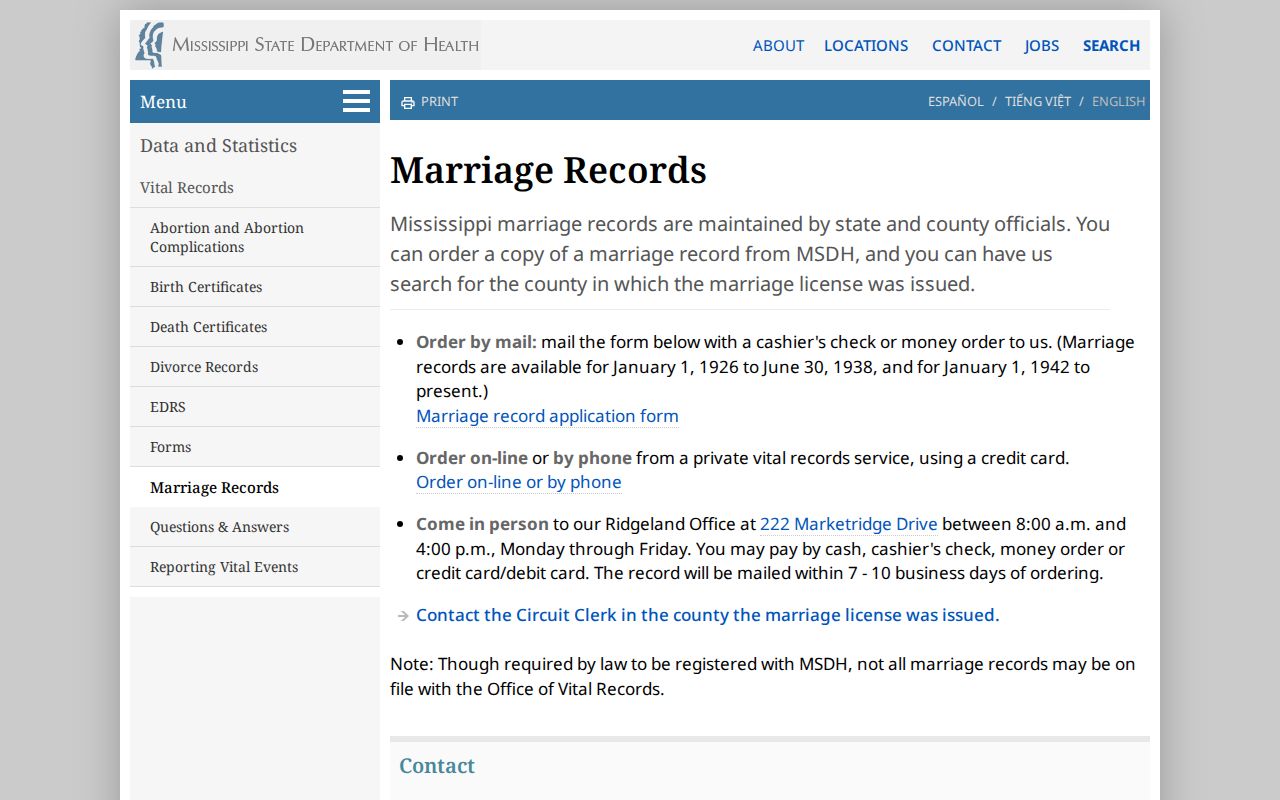
That split prevents a failed state search from being mistaken for proof that no county marriage record exists.
Find Mississippi Divorce Records
A divorce complaint is filed in Chancery Court where venue and residence law permit. The file may contain the complaint, service or waiver, temporary orders, financial material, discovery, settlement papers, trial orders, and the final decree. Mississippi recognizes irreconcilable differences by agreement and fault grounds. Irreconcilable differences is not a unilateral shortcut. The court may decide support, property, custody, and other relief before entering the decree.
When the county is unknown, request an MSDH divorce-index search. The five-year search locates the county but does not provide the decree. Then give the Chancery Clerk the parties' names at divorce, approximate date, cause number if known, and the exact document requested. Protected personal data, medical information, child identifiers, and sealed exhibits may be withheld or redacted.
A final decree ends the marriage and states the relief ordered. An annulment is different because it addresses a qualifying defect rather than simply ending a valid marriage. For certification, request the signed decree and any later order needed for the stated purpose. A docket or state index result may locate the case, but it does not substitute for the clerk's certified instrument. Filing fees, service, publication, copies, and an indigency request depend on the case and county. A sworn indigency form generally discloses income, assets, expenses, and dependents for judicial review.
Mississippi Marriage Record Fees
MSDH charges are statewide. County marriage-license totals, divorce filing costs, local certified copies, service, and payment charges vary. A state search fee is nonrefundable when no record is found, except the added-copy amount. Ask the Circuit or Chancery Clerk for an itemized quote.
| Item | Amount | Source |
|---|---|---|
| Marriage search and certified copy | $17 | MSDH |
| Additional same marriage record | $6 | MSDH, same order |
| Divorce-index five-year search | $17 | MSDH, no decree included |
| Marriage license | County collection total | Circuit Clerk |
| Divorce filing or certified decree | County/case dependent | Chancery Clerk |
Mississippi Vital Records Office
The Mississippi State Department of Health, Bureau of Vital Records accepts covered marriage orders and divorce-location searches. Its office is at 222 Marketridge Drive, Ridgeland, and its published weekday counter hours are 8 a.m. to 4 p.m. In-person marriage orders are mailed within seven to ten business days. Mail requests go to Mississippi Vital Records, P.O. Box 1700, Jackson, MS 39215-1700.
The Bureau's official service menu appears below and helps distinguish state vital records from county court documents.
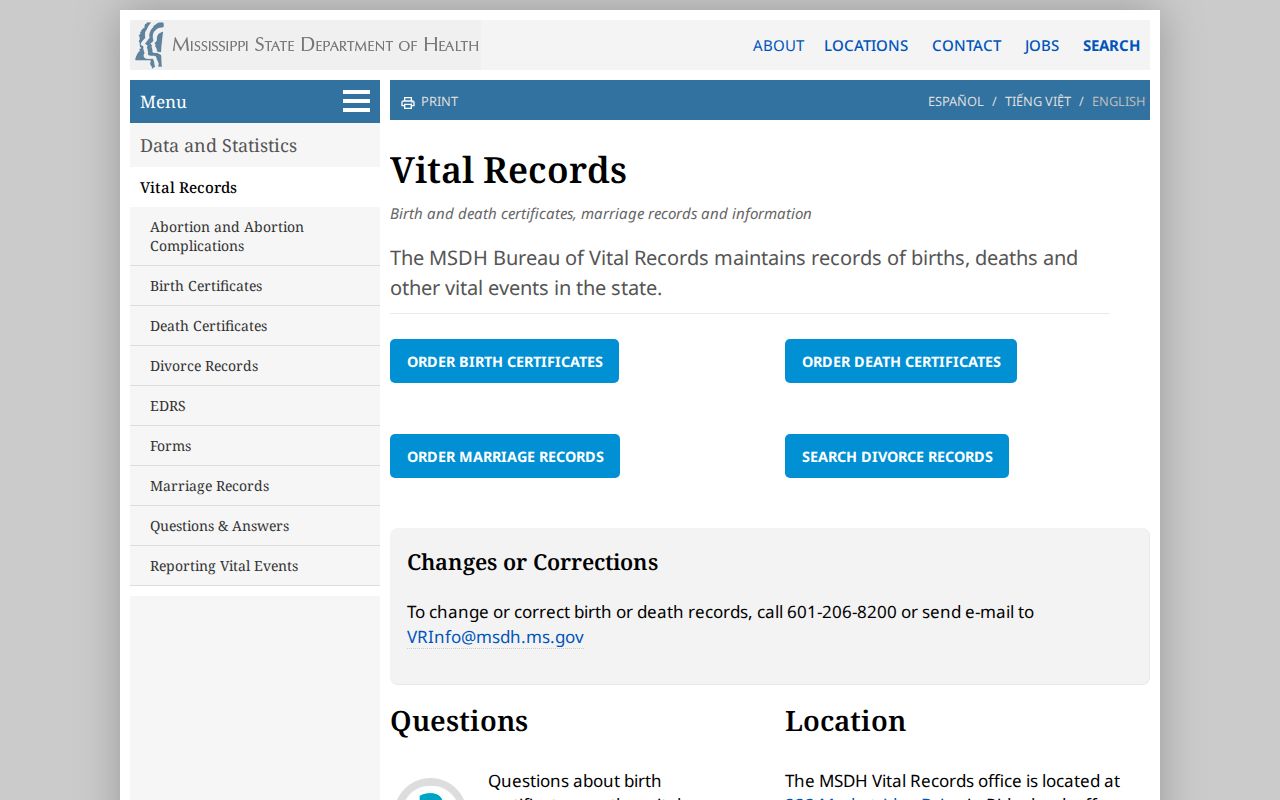
Use the state channel for its indexed product, then use the named county clerk when an original license or divorce decree is required.
Eligible MSDH marriage-record requesters include the subject, spouse, parent, grandparent, sibling, child, grandchild, guardian, or legal representative, with proof where required. A photo ID copy accompanies a mailed request. The office lists 601-206-8200 and VRInfo@msdh.ms.gov for contact.
MSDH Bureau of Vital Records
222 Marketridge Drive
Ridgeland, MS
601-206-8200
Mississippi Record Eligibility Rules
The official Mississippi vital-record FAQ shown below addresses eligibility, coverage gaps, fees, and identification.
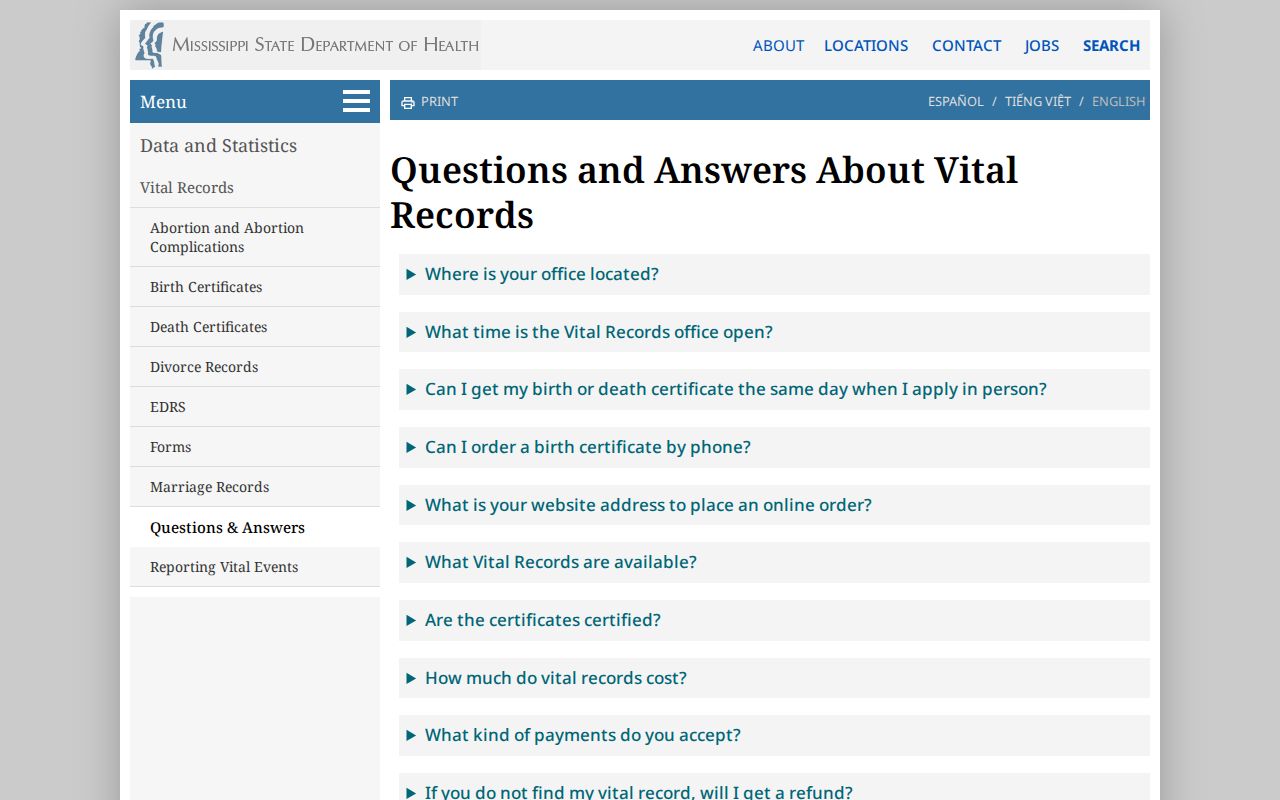
Its rules apply to the state product. Access to a Chancery Court file still depends on court rules, sealing, redaction, and the particular document requested.
Mail payment for the MSDH marriage application uses a cashier's check or bank or postal money order. Do not mail cash or a personal check. Include a self-addressed stamped legal-size envelope and the requested proof. Online or phone ordering uses the vendor linked by MSDH and may add vendor charges.
Accepted identification listed in the state materials includes a state driver license or photo ID, employment or school ID, U.S. military or tribal ID, immigration status documents, and a U.S. passport. A guardian or legal representative also supplies proof of authority. The application asks for the applicant's relationship and purpose, so eligibility should be established before payment. If the record falls in a state coverage gap, the correct response is a county search, not a broader or less precise state order.
Older Mississippi Marriage Records
Genealogy searches often need county books rather than the current state order process. Search Circuit Clerk marriage books using both parties' names, name variants, the likely county, and a range of years. For older divorce matters, ask the Chancery Clerk about party indexes, minute books, decree books, and archived case packets. The state coverage gap from mid-1938 through 1941 makes the county route especially important for marriage research.
An archive or library can help identify an old reference, but the legal certified copy remains with the record custodian. Public notices may offer a clue, yet the recorded marriage return or filed Chancery decree is the controlling proof. When a clerk must conduct a manual archive search, request an estimate for staff time, copies, certification, and postage before work begins.
Locate Mississippi County Records
Choose the issuing or filing county in the directory of all 82 Mississippi counties. Contact its Circuit Clerk for the marriage license and completed return. Contact its Chancery Clerk for the divorce petition, orders, and certified decree. Older marriage books and Chancery minute books may require a manual index, archive search, counter visit, or mail request, so include name variants and an approximate year.