
Mississippi's Split Clerk Structure
Mississippi preserves the constitutional divide between courts of law and courts of equity through separate clerk offices. The Circuit Clerk maintains Circuit Court criminal and civil dockets, receives pleadings, issues process, supports juries, preserves judgments, and issues marriage licenses. The Chancery Clerk maintains Chancery Court dockets for divorce, custody, support, estates, wills, guardianships, conservatorships, commitments, land-title cases, and other equity matters. The Chancery Clerk also records deeds and liens and serves as clerk to the board of supervisors, although those administrative and land indexes are not court dockets.
Both are elected county officers generally serving four-year terms. The offices exist separately in each county even when Circuit judges or chancellors travel within multicounty judicial districts. That distinction is critical: a judicial district can share a bench without sharing one record room. County Court records are commonly kept by the Circuit Clerk or a County Court clerk where that court exists, but local practice must be confirmed. Justice and Municipal Court files stay with their own clerks unless an appeal creates a later Circuit or County Court record.
Mississippi Circuit Clerks
A Circuit Clerk is the first local contact for felony prosecutions and general civil cases at law. The office opens and maintains the cause file, enters docket events, receives pleadings, issues summonses and other process, preserves orders and judgments, supports jury administration, and authenticates copies. Circuit records can include indictment, arraignment, plea, motions, trial events, verdict, sentence, costs, post-conviction filings, and appeal papers. Civil files can contain complaint, service, answer, motions, orders, verdict, judgment, execution, garnishment, satisfaction, and notice of appeal.
- Circuit Court felony and criminal case files.
- Circuit Court civil law actions and judgments.
- Jury records and process issued in Circuit cases.
- Marriage licenses and recorded returns issued by the county.
- Commonly County Court files, subject to the county's arrangement.
- Appeal records received from lower courts or transmitted to appellate courts.
Mississippi Chancery Clerks
A Chancery Clerk is the custodian for equity and domestic matters, not merely a second counter for Circuit records. Divorce, custody, support, separate maintenance, contempt, land-title disputes, estates, wills, guardianships, conservatorships, and commitments belong in Chancery. Probate is not assigned to a separate probate court in Mississippi. The same office also records deeds, liens, and land instruments and serves the board of supervisors. Search the correct index because a deed book, board minute, and Chancery cause docket are distinct record systems even though one clerk holds them.
- Divorce, custody, support, paternity, and related domestic files.
- Probate estates, wills, letters, inventories, claims, accountings, and decrees.
- Guardianship and conservatorship cases, with protected details restricted.
- Equity, land-title, and commitment proceedings.
- Deed, lien, and land indexes maintained in the recorder role.
Circuit Clerk vs. Chancery Clerk
The fastest route follows the court named on the case. Contact the Circuit Clerk for Circuit criminal or civil law records and the Chancery Clerk for family, probate, land, and equity cases. Lower-court records may never enter either system unless appealed. A marriage license is a Circuit Clerk record, while a divorce decree is a Chancery Clerk record.
| Record / Case Type | Circuit Clerk | Chancery Clerk |
|---|---|---|
| Felony criminal cases | Primary custodian | No |
| General civil law cases | Primary custodian | No |
| County Court cases | Common local custodian; verify county | No ordinary role |
| Family, divorce, and custody | No | Primary custodian |
| Probate, estates, and guardianships | No | Primary custodian |
| Marriage licenses | Issues and records | No |
| Real property and deed records | No | Recorder and index custodian |
| Justice or Municipal cases | Only after applicable appeal or transfer | Only where jurisdiction creates a Chancery file |
What Mississippi Court Clerks Do
Mississippi clerks create and preserve the official record without acting as legal advisers. They accept filings, assign cause numbers, enter events, maintain indexes, issue authorized process, collect and receipt fees, manage exhibits and archived files under local procedures, and produce plain or certified copies. They apply court orders and privacy rules when material is sealed, expunged, or redacted. The Mississippi Public Records Act provides a framework for nonexempt public-body records, but it does not defeat judicial control, a sealing order, Youth Court confidentiality, adoption restrictions, or protected personal data.
- Accept pleadings and assign or preserve the cause number.
- Maintain the docket, official file, orders, judgments, and decrees.
- Issue summonses, subpoenas, writs, and other authorized process.
- Collect filing, copy, certification, and court-accounting payments.
- Authenticate certified or exemplified copies when requested.
- Support MEC e-filing and PAMEC access where the court participates.
Request Certified Mississippi Court Records
A certified copy carries the clerk's attestation that it reproduces an official filed record. Courts, agencies, banks, title companies, and other receiving authorities may demand that authentication. An informational screen print or plain copy is not equivalent. Mississippi has no single certified-copy form or price used by all county clerks, so identify the office first and ask for its payment, mailing, identification, and return-delivery rules.
- Identify the filing county and whether the Circuit, Chancery, County, Justice, or Municipal clerk holds the file.
- Gather the cause number, party names, filing or disposition year, and exact document title.
- Ask whether the record is online, at the counter, or archived, and request a written estimate for search, copy, certification, and delivery.
- Submit the clerk's form or a clear letter by an accepted channel. Include payment only in the form directed and never mail cash.
- Check the seal or certification on receipt and keep the clerk's transmittal if another authority will use the copy.
Records Request Form Fields
A useful Mississippi clerk request gives enough detail to locate one file and price the service. State whether inspection, a plain copy, a certified copy, or an exemplified copy is needed. Include a maximum approved cost and desired delivery method so the clerk can pause before exceeding the budget. The office may ask for identity or purpose only when legally relevant to restricted access.
| Field | Required | Notes |
|---|---|---|
| County, court, and division | Yes | Directs the request to the correct Mississippi custodian. |
| Cause number | If known | Fastest identifier; preserve letters and hyphens. |
| Party names | Yes | Give full names, roles, aliases, or former names when relevant. |
| Filing or disposition dates | Yes | Narrows a name-only or archived search. |
| Documents and copy type | Yes | Name each item and choose plain, certified, or exemplified. |
| Delivery and maximum cost | Yes | Choose inspection, paper, or electronic delivery and set a limit. |
| Requester contact | Yes | Provide postal, email, and phone details for estimates and return. |
Mississippi Clerk Fees
No researched statewide total safely substitutes for a county quote. Copy and filing costs depend on record, service, case, court, statute, and county practice. Public-record charges may reflect actual search, review, redaction, and reproduction. Certified copies cost more than plain copies, while exemplification is a special service. Postage, archive retrieval, oversized media, and payment convenience fees may also apply. Ask the clerk to itemize the estimate.
| Item | Amount |
|---|---|
| PAMEC trial access | Paid subscription; current charges appear in registration |
| Plain clerk copy | County and statute dependent |
| Certified or exemplified copy | Confirm document, page, and authentication charges |
| Search or archive retrieval | Confirm staff time and off-site retrieval estimate |
| Circuit, Chancery, County, or Justice filing | Case and county dependent |
| Indigency request | No fee to apply where procedure allows; judge decides |
Mississippi Clerk Forms
Mississippi has no one records-request or certified-copy form that binds all county clerks. The Mississippi Judiciary publishes statewide court rules, directories, and resources, while the filing county supplies local forms and payment directions. Common requests can still be described consistently:
- A court-record request identifies a cause, documents, access method, and copy authentication.
- A marriage-license application follows the issuing Circuit Clerk's process.
- A probate or estate filing packet follows the local Chancery Clerk and court requirements.
- An indigency filing uses sworn financial information for judicial review where allowed.
Mississippi Mail and Online Access
Mississippi Electronic Courts is implemented by participating courts rather than every local court. Public, non-attorney access uses PAMEC registration, which is distinct from attorney e-filing and from a clerk copy request. Subscriber material is informational; certified records still come from the clerk. A nonparticipating or paper-era court may accept requests by counter, mail, email, or fax according to local rules.
The First Circuit Court's official explanation illustrates how Mississippi Circuit districts can include several counties.
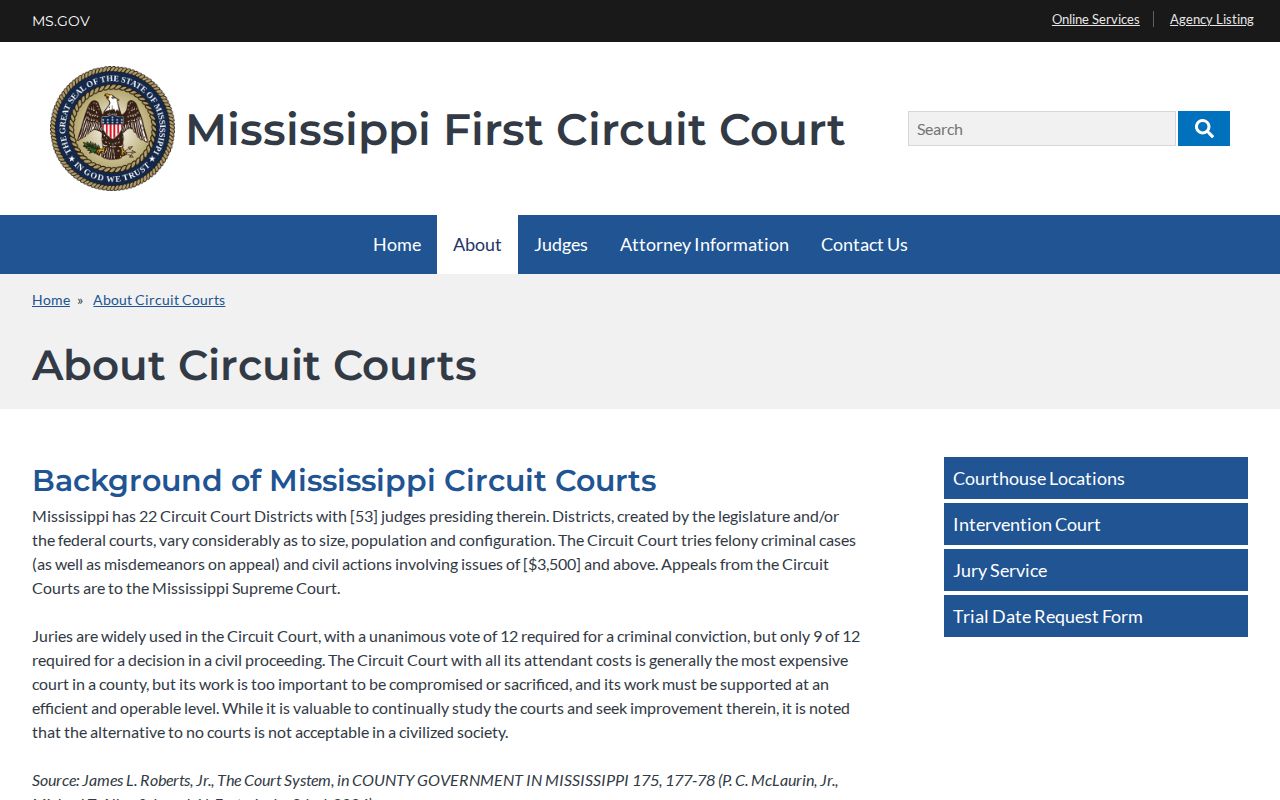
The district structure shown there reinforces the statewide rule: judges may be shared, but each filing county's clerk remains the local record custodian.
Find Mississippi County Clerks
Use the directory of all 82 Mississippi counties to locate the Circuit Clerk, Chancery Clerk, or lower-court clerk for the filing county. Ask that office about its address, hours, portal, archived years, accepted request channels, payment methods, turnaround estimate, and certification options. Do not send a Chancery divorce request to the Circuit Clerk or a felony request to the Chancery Clerk.